Welcome to Zhengzhou Haloong Machinery Manufacturing Co., Lt Website! Collect this site SITEMAP Contact US


A press is usually bought on tonnage, yet nominal pressure only answers whether a billet can be deformed. Yield on heavy die forgings depends more on whether strike energy repeats, whether off-centre load is constrained, and whether the cycle holds.
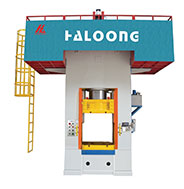
The HLDS-2500F listed on this site is rated at 25,000 kN nominal pressure with a permissible maximum load of 40,000 kN, 500 kJ of kinetic energy in the moving mass, a 700 mm slide stroke, 16 strokes per minute, a minimum shut height of 1,020 mm, a 1,350 × 1,300 mm worktable and two 235 kW motors. Among these figures the 500 kJ and the 700 mm stroke deserve the closest reading: heavy forgings need deformation work, and deep die cavities need stroke. A press short on either will push the job towards a larger machine, or towards more strikes than the die can tolerate.
A second capability is easily overlooked: a large press can also run small jobs. Because strike energy is set stroke by stroke, a 2,500-tonne machine can form large flanges or gear rings and, at lower energy, press small parts without changing its idle-stroke cycle. For a mixed, low-volume order book this flexibility is worth more than tonnage alone.
Off-centre load control matters just as much. Uneven heating or a misplaced billet concentrates load in a single instant, so the frame and the screw-and-nut pair need margin. Without it, the first signs are uneven flash and drift at bottom dead centre — symptoms often misread as die wear, and chased in the die shop rather than at the press.
One process difference belongs in the comparison too. Technical notes on this site state that, for the same forging, a crank press is usually specified at 1.3 to 1.8 times nominal pressure, because a screw press delivers its energy as an impact rather than through a crank mechanism. That difference should be carried into the investment calculation, not only into the price per tonne.
For a buyer, the practical test is straightforward: ask for the energy and the stroke at the tonnage you actually need, then check the die envelope and the cycle against your own part family.
References